PART TWO: PROGRAM LOGICS AND THEORY OF CHANGE

1. Purpose and key components of Program Logics

A Program Logic demonstrates how a program is expected to work. It articulates the program’s inputs and activities; and how these link to intended outcomes.

A Program Logic is like a biscuit recipe: listing the ingredients needed (inputs), in order to follow the recipe (activities); to create the biscuits (outputs), to reduce short-term hangry-ness and increase happiness of children (intended outcomes).

At its most basic, a Program Logic provides a diagrammatic or visual demonstration of the program’s operational functions and activities, and the changes (outcomes) we are seeking to achieve as a result of delivering the program.

It is also an opportunity to articulate other important contextual information about the program: its purpose, target group, the problem statement or need, underpinning principles and assumptions, external factors, and importantly, the theory of change.

There is no ‘one’ way to present a Program Logic. Program Logics can vary in their simplicity or detail. For the purposes of procurement; providing more detail rather than less is an opportunity to clearly convey the rigour and consideration that has been part of the program planning and design. Some services may develop two program logics: a simplified version illustrating just the key elements as a public-facing resource; and another that provides greater operational detail for funding and/or governance processes.

The key components of a Program Logic may include:

  • Program overview: Your elevator pitch – the program’s purpose / aim; the target group; where the program will be delivered
  • Inputs: Resources required to implement program activities.
  • Activities: Key program activities to be conducted.
  • Outputs: The products of the program activities (e.g. number of groups). In some cases, activities and outputs are merged into one category.
  • Outcomes: The changes expected as a result of delivering the program activities. See below for more information about outcomes.
  • Principles: The core principles underpinning the program.
  • Theory of Change / Theoretical framework: The theories / theory of change underpinning the program.
  • Problem statement: The need or issue that the program is responding to (this may also be part of a Theory of Change).
  • External factors: The factors outside the control of the program, which may impact upon its delivery and effectiveness.


A note on outcomes

Outcomes are the changes expected (e.g. in the target group) as a result of delivering the program activities.

Outcomes are often conceptualised or presented as ‘short, medium and long-term’. There is often confusion about what these timeframes refer to, in relation to clients’ involvement with their programs. The short answer, is that there is no right answer (sorry!). It depends on your program and what you are setting out to do.

Some programs, particularly those that are involved with clients for short periods of time, may identify ‘short-term outcomes’ as the changes they are hoping for by the time they have finished their involvement with a client.

Programs that support people over longer periods of time, may identify initial or short-term outcomes they are seeking during clients’ involvement in their program; and medium-term outcomes later in their involvement or upon program completion.

The diagrams below provide examples of how different programs may identify outcomes at different stages of program involvement.

A program that provides one-off or short-term support to individuals / families:

Click to enlarge

A program that supports individuals / families over a longer duration:

Example 1: 

Example 2: 
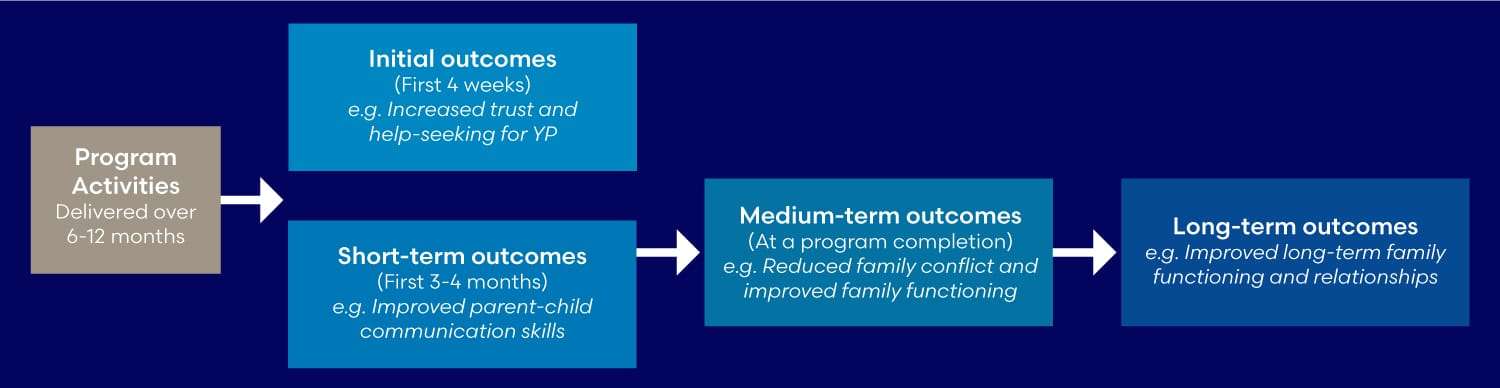
Longer-term outcomes (or impact) are usually outside the scope of the program, and subject to external factors and influences. They form part of the theory of change of the program. Long-term outcomes can be represented on a Program Logic, but a program should not necessarily be expected to collect data on them, as they are subject to a range of other external influences outside the scope of the program.

In short, there are no hard and fast rules. Programs should consider what changes they are hoping to see, and at what points in relation to their target group’s involvement with the program.

Alternatively: You may not want to use the terms, ‘short, medium and long-term’ at all. Ultimately, it is about demonstrating a sequence or ‘chain’ of outcomes (if this, then this, then this); and understanding which of those are within the scope of your program.

A note on reporting of outcomes: It may not be feasible for programs to collect data and/or report on all the short and medium-term outcomes in their program logic. This could be for a range of reasons, such as the number of outcomes, time and resource constraints for data collection, or because of a lack of outcome measurement tools on specific domains. Service providers may work in partnership with funding agencies to consider which outcomes in their program logic are the most important, that they may include in their reporting.

PART TWO: PROGRAM LOGICS AND THEORY OF CHANGE

1. Purpose and key components of Program Logics

A Program Logic demonstrates how a program is expected to work. It articulates the program’s inputs and activities; and how these link to intended outcomes.

A Program Logic is like a biscuit recipe: listing the ingredients needed (inputs), in order to follow the recipe (activities); to create the biscuits (outputs), to reduce short-term hangry-ness and increase happiness of children (intended outcomes).

At its most basic, a Program Logic provides a diagrammatic or visual demonstration of the program’s operational functions and activities, and the changes (outcomes) we are seeking to achieve as a result of delivering the program.

It is also an opportunity to articulate other important contextual information about the program: its purpose, target group, the problem statement or need, underpinning principles and assumptions, external factors, and importantly, the theory of change.

There is no ‘one’ way to present a Program Logic. Program Logics can vary in their simplicity or detail. For the purposes of procurement; providing more detail rather than less is an opportunity to clearly convey the rigour and consideration that has been part of the program planning and design. Some services may develop two program logics: a simplified version illustrating just the key elements as a public-facing resource; and another that provides greater operational detail for funding and/or governance processes.

The key components of a Program Logic may include:

  • Program overview: Your elevator pitch – the program’s purpose / aim; the target group; where the program will be delivered
  • Inputs: Resources required to implement program activities.
  • Activities: Key program activities to be conducted.
  • Outputs: The products of the program activities (e.g. number of groups). In some cases, activities and outputs are merged into one category.
  • Outcomes: The changes expected as a result of delivering the program activities. See below for more information about outcomes.
  • Principles: The core principles underpinning the program.
  • Theory of Change / Theoretical framework: The theories / theory of change underpinning the program.
  • Problem statement: The need or issue that the program is responding to (this may also be part of a Theory of Change).
  • External factors: The factors outside the control of the program, which may impact upon its delivery and effectiveness.


A note on outcomes

Outcomes are the changes expected (e.g. in the target group) as a result of delivering the program activities.

Outcomes are often conceptualised or presented as ‘short, medium and long-term’. There is often confusion about what these timeframes refer to, in relation to clients’ involvement with their programs. The short answer, is that there is no right answer (sorry!). It depends on your program and what you are setting out to do.

Some programs, particularly those that are involved with clients for short periods of time, may identify ‘short-term outcomes’ as the changes they are hoping for by the time they have finished their involvement with a client.

Programs that support people over longer periods of time, may identify initial or short-term outcomes they are seeking during clients’ involvement in their program; and medium-term outcomes later in their involvement or upon program completion.

The diagrams below provide examples of how different programs may identify outcomes at different stages of program involvement.

A program that provides one-off or short-term support to individuals / families:

Click to enlarge

A program that supports individuals / families over a longer duration:

Example 1: 

Example 2: 

Longer-term outcomes (or impact) are usually outside the scope of the program, and subject to external factors and influences. They form part of the theory of change of the program. Long-term outcomes can be represented on a Program Logic, but a program should not necessarily be expected to collect data on them, as they are subject to a range of other external influences outside the scope of the program.

In short, there are no hard and fast rules. Programs should consider what changes they are hoping to see, and at what points in relation to their target group’s involvement with the program.

Alternatively: You may not want to use the terms, ‘short, medium and long-term’ at all. Ultimately, it is about demonstrating a sequence or ‘chain’ of outcomes (if this, then this, then this); and understanding which of those are within the scope of your program.

A note on reporting of outcomes: It may not be feasible for programs to collect data and/or report on all the short and medium-term outcomes in their program logic. This could be for a range of reasons, such as the number of outcomes, time and resource constraints for data collection, or because of a lack of outcome measurement tools on specific domains. Service providers may work in partnership with funding agencies to consider which outcomes in their program logic are the most important, that they may include in their reporting.
The Youth Coalition of the ACT

Subscribe

Name
Sign up to our email groups
Search

T | (02) 6247 3540
E | office@youthcoalition.net


The Youth Coalition of the ACT
46 Clianthus St O’Connor ACT 2602